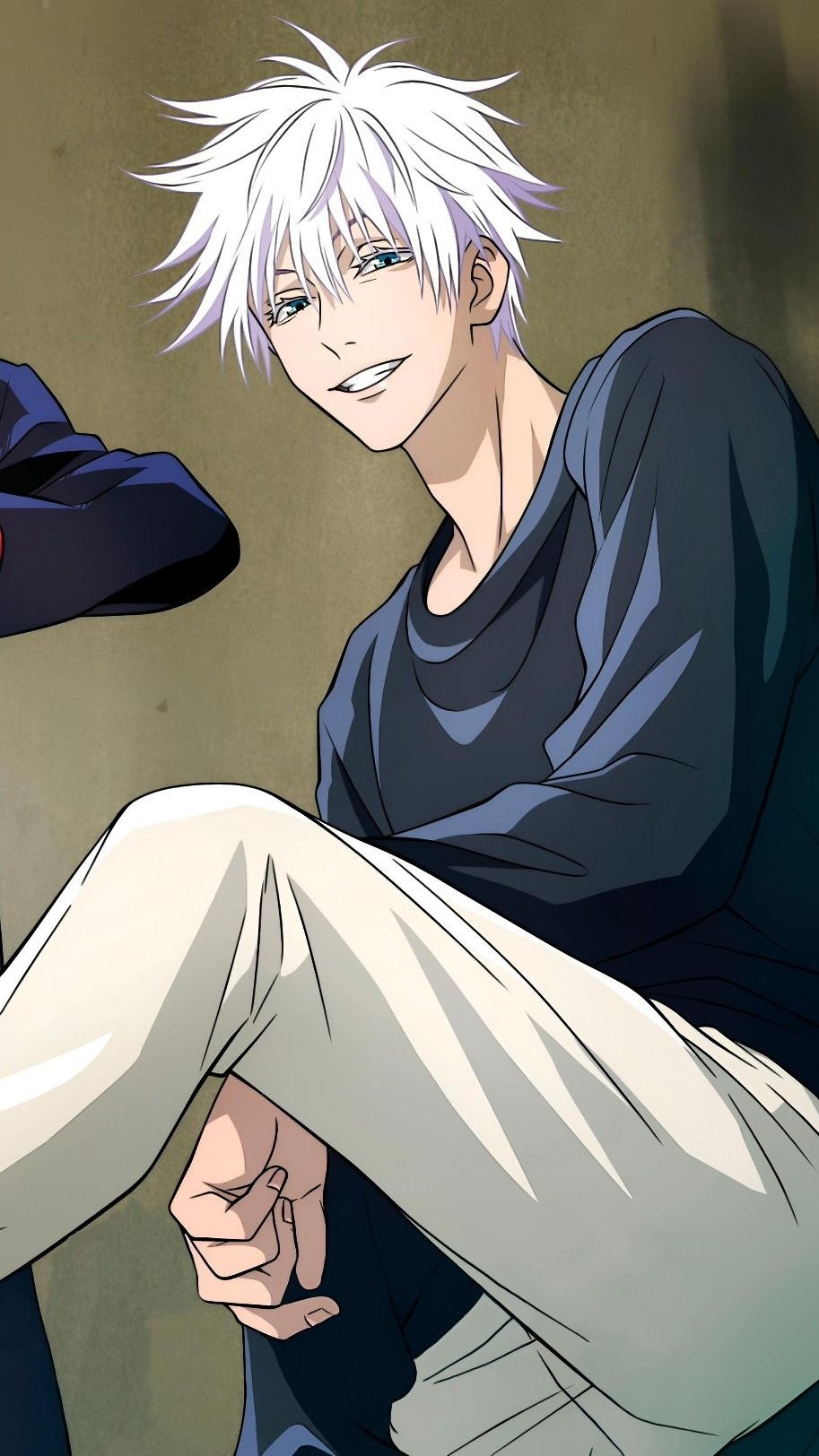
Imagine a world where the chilling reality of demon farms and the desperate hope of human children collide with an individual so powerful, so utterly in control, he's practically a god among mortals. That's the electrifying premise we're diving into today: Satoru Gojo, the strongest Jujutsu Sorcerer, stepping into the terrifying yet hopeful narrative of The Promised Neverland. This isn't just a fantasy; it's a thought experiment that fundamentally redefines both beloved series, creating a crossover scenario ripe with unprecedented possibilities and mind-bending consequences.
At its core, The Promised Neverland plunges us into a seemingly idyllic orphanage where children are raised with love, only to discover they are livestock for a demonic society. Their survival hinges on intellect, courage, and the bonds they share. Now, introduce Satoru Gojo – a man whose very existence warps reality, capable of stopping all attacks before they land and erasing anything in his path. How does such an unstoppable force fit into a world built on intricate deceptions, desperate escapes, and the sheer terror of the unknown? The answer is a game-changer, promising to unravel the entire demon-human power structure and ignite a new kind of rebellion.
The Unstoppable Force Meets The Promised Neverland's Desperate Hope
Satoru Gojo, born with the rare combination of Six Eyes and Limitless, is a figure of immense power in his own world. He's not just strong; he's fundamentally different. Limitless allows him to manipulate space at an atomic level, essentially creating infinite distance between himself and anything that approaches. Coupled with Six Eyes, which grants him unparalleled perception of cursed energy and the ability to minimize energy consumption, Gojo is a walking cheat code. He can repel, attract, or even erase targets from existence with techniques like Blue, Red, and Purple, and his Domain Expansion, Unlimited Void, overwhelms opponents with infinite information, rendering them paralyzed.
Conversely, The Promised Neverland presents a world where humanity is prey. The children of Grace Field House – particularly Emma, Ray, and Norman – navigate a meticulously crafted deception, their lives ending as meals for sentient demons. These demons range from feral, low-level creatures to highly intelligent, ancient beings who have forged a treaty to maintain the "cattle farm" system. The Mamas, human caretakers like Isabella, are their primary enforcers, maintaining order through manipulation and the threat of severe punishment.
The collision of these two universes creates immediate tension and unparalleled narrative opportunities. We'll be dissecting , examining how his very presence negates almost every physical threat the demons could pose, and how his perception would instantly dismantle the carefully constructed lies of the orphanage.
Envisioning Satoru Gojo's Role in a Demonic World
With his incredible abilities, Gojo wouldn't just be an advantage for the children; he'd be an existential threat to the entire demonic food chain. His primary goal in Jujutsu Kaisen is to reform a corrupt system by raising a new generation of powerful and independent sorcerers. This aligns uncannily well with the plight of the children in TPN. He’d undoubtedly see their systematic culling as an abhorrent practice, reminiscent of the entrenched corruption he fights in his own world.
Would he be a silent guardian, empowering the children to lead their own revolution, or would he directly dismantle the system with overwhelming force? Given Gojo's personality – confident, often irreverent, yet deeply caring for his students – it's likely he'd take a direct, albeit theatrical, approach. He might enjoy watching the children strategize, but wouldn't hesitate to step in when lives are truly on the line. Unpacking this further, we'll as he navigates a world where children are commodities.
Confronting the Architects of the Farm System
The threats in The Promised Neverland are diverse, ranging from the immediate danger of the 'Mamas' and the secret routes, to the larger, more ancient demonic society and its ruling powers. For Gojo, who can teleport, fly, and create impenetrable barriers, the typical escape routes and stealth missions would be rendered largely obsolete. The demons' physical prowess, even that of the strongest Royal Family members, would likely be nullified by Infinity. Gojo's offensive capabilities mean that any demon, no matter how large or ancient, would face an instantaneous and overwhelming threat.
This begs the question of how the world's most powerful entities would react to a being they cannot comprehend or harm. His Six Eyes would instantly detect the 'tells' of demons, differentiating them from humans, and his Reverse Cursed Technique would make him virtually unkillable by conventional means. We'll delve into , exploring how his sheer power forces the demon world to adapt or perish.
The Dynamics Between Gojo and the Grace Field Trio
The core of The Promised Neverland lies in the incredible intelligence, resilience, and teamwork of Emma, Ray, and Norman. These children, despite their age, possess strategic minds that rival adults. How would they react to Gojo? Initially, with awe and perhaps suspicion, given his unconventional nature and overwhelming power. However, Gojo has a knack for connecting with young, bright minds, seeing their potential. He'd likely be impressed by their ingenuity and determination.
Emma's unwavering optimism, Ray's calculated cynicism, and Norman's unparalleled genius would find a powerful, if eccentric, ally in Gojo. He could provide the muscle and direct protection, allowing them to focus on the broader strategy of understanding and dismantling the demon society. Their combined intellectual and physical prowess would be truly formidable. Delve into to see how this unlikely team could redefine the future of both species.
Plot Twists and Ethical Quandaries
Gojo's arrival wouldn't just shift the balance of power; it would shatter the foundational plot points of The Promised Neverland. The desperate search for the seven walls, the encounters with benevolent demons like Mujika and Sonju, and the perilous journey through the wilderness would all be radically altered. Gojo could simply teleport the children to safety, or clear a path through any obstacle. This leads to fascinating questions about what new conflicts would arise. Would the human world beyond the farms embrace him? Would the demon kings seek to negotiate or unleash unknown forces?
This brings us to the more complex ethical considerations. Gojo, while protective, isn't above lethal force. His methods are often brutal, aimed at eliminating threats decisively. How would the children, who often seek a peaceful coexistence or a way to escape without mass slaughter, reconcile with Gojo's willingness to eradicate the demon threat? This tension between overwhelming power and moral complexity is key. We'll and to fully grasp the weight of his intervention.
The crossover between Satoru Gojo and The Promised Neverland isn't merely a "what if"; it's a testament to the transformative power of imagination. It invites us to consider how one character, imbued with extraordinary power and a unique moral compass, could rewrite the destiny of an entire world. Get ready to explore every facet of this thrilling hypothetical, where infinite power meets infinite hope.